Friday, May 30, 2008

Writing Rules that Make Sense - Sort of

Quick tip for Writing Books: If you've been writing for awhile, you are beginning to have an idea of which areas you are strong in, and which areas you need to spend time perfecting. Look for specialized books in the area you need to work on (or the area you haven't researched yet). There are all kinds of style books out there (Thanks Strunk and White), but there are also books that focus on grammar, POV, characters, dialogue, etc. Don't buy them all! Just the one that covers in depth the aspect you need the most help with.
***


You should see my inbox. There are days I have to wade through reams of advertisements in order to find that e-mail from my agent I've been waiting for, or that note from a friend, or, even more fun, a fan!


It's not that I have a spam problem. It goes back to the days when I was starting out as a writer. I figured it was a good idea to sign up for a bunch of writing focused magazines, book clubs, contests, etc. I mean, I'm a writer, right? So I should have all sorts of writerly materials filling my inbox.


Daily, I am reminded of a contest site where I'm invited to enter my choice of 1,000,000,000 contests being run at THIS VERY SECOND. I'm told I qualify for a FREE BOOK, and that I have a CHANCE TO WIN a book by some author I've never heard of! Woo Hoo!


Well, I got to thinking.


I love it when that happens. Thinking. Makes me remember what my brain is for.


I got to thinking about how a writer should make the best use of all the opportunities to enter contests, do writing exercises, etc. Here are my thoughts on the subject:


Nearly every writing book you pick up will be jammed packed with writing exercises. Each one focusing on a specific aspect of writing. There are entire books dedicated to writing exercises, such as Brian Kiteley's book The 3 A.M. Epiphany: Uncommon Writing Exercises that Transform Your Fiction. I happen to own this book. I love the cover.


Then there are the contests. Oh my, oh my, there are contests. Contests where you are given the first sentence and you have to write the rest of the story, contests on specific topics, on specific genres, short story, poetry, inspirational, long story, poems about dogs; it's nearly endless.


So, should a writer be spending time doing writing exercises from a book? Entering contests?


Yes.


And no.


Here's what I say: Books like 3 A. M. are great because they force you through a sort of writer's mental gymnastics. They get you thinking out of your regular patterns and can help you to add dimension and depth to your writing. They are focused on specific aspects of writing, so you can work on areas you need the most help with. So, in a nutshell, they are fantastic.


But. . .


Well, lets talk about contests for a moment. If you ever land an agent, or a publisher, they are going to ask you if you have ever won a contest. It looks good to say you have won something for your writing. If the contest was a half decent one, a notation of your win may even grace the cover of your upcoming book. Add to that the fact that when you submit your work to a contest, you are submitting to much the same intellectual process as if it were to a publisher. Your entry needs to be properly formatted, and clean. It must be well written. It will be judged by a panel, it will be compared to the work of other authors. This is a good thing, especially if you are new to writing. It's a good way to get your feet wet.


But. . .


Here's the rub, as far as I'm concerned. Writing exercises and entering contests take a lot of time. Hours and hours of focused work go into preparing a manuscript for a contest (or, at least it should if you want to win). Writing exercises are set up for you, and you follow the format that is presented to you (in other words, you work on what someone else suggests you work on). This takes time away from your masterpiece; your book (or whatever it is you are writing that you desire to see published).


Okay, it is totally worth the time it takes to become a better writer, to get feedback on your writing and to improve your skill sets. You may want to consider blocking some of your weekly writing time for just such pursuits.


But. . .


Don't get distracted from your real goal: to finish your own work.


This past winter I opted out of all contests and writing exercises.


I wrote two books, and two short stories.


All of them are either published (the short stories), or being published (my books).


I took the time to focus what I had learned on my books, rather than spreading my time out on contests and exercises.


The take home lesson: Do what you need to do to become a great writer, beginning with making the best use of your time.


Peace.

Wednesday, May 21, 2008

Movies can be fiction too.


Lars and the Real Girl


Go rent this movie.


Go on.


Go rent it.


It will remind you what grace looks like.

Tuesday, May 20, 2008

Sneak Peek at a New Anthology


Women of Passion is a new anthology that features my writing. My short story Master of the Sneaky Hug is found within its pages.

I'll have more information about the official release date and how to order in a later post. Here is the cover:

Ooooo. Shiny.

With two books in print that carry my work, I'm feeling all "official"! The whole writer gig is a good one.

I'll be even more excited this coming year as two more books (these one of my own work) will be released!

For now, I'm content to gaze upon the pretty cover of this new addition to my family of books.

Do the happy dance with me!

Next blog will continue with our books on writing series and more quick tips, and conflicting writing advice.

Books on Writing, Part One

Books on Writing Quick Tip: Look for compilation books about writing. They give you a broad perspective on a wide range of subjects. This is helpful especially if you are just starting out and are wondering where to focus your writing. The book I'm talking about today is an example of a compilation book.


Eliza Clark has put together a slim book called Writer's Gym. It's available at Amazon.ca (but not at Amazon.com for some reason). It's published by Penguin Canada (Yeah Canada!). It's slim, but it's good. I'll say this here, if you are sensitive to language, this may not be the book for you. It's mainstream and there are examples of harsh language that are prevalent in our culture. Not that the book is over run with it, but it's there. Even Margaret Atwood uses the "f" word. And here I was thinking she was above all that. :)
Here are a few things I like about the book.
~The chapters are short. Some barely two pages long. These short chapters give you the feeling of a brief, intense "workout". Each chapter is contributed by a different person (author) and is dedicated to a different concept of writing. There are interviews too, which are just okay. I like the "Five Rules for Writers" that different authors list. They give good tips, and show how diverse approaches are to writing and what's important (and what's not) to different writers.

It's in a list of rules for writers that I want to linger for a moment. Kate Pullinger (she's Canadian born, now living in England) contributed her list of five rules. Rule #1 Never use adjectives and adverbs. Well, she lets up a bit on the adjectives (whew!) but insists writing be adverb free.

This is a good rule. A rule to be followed. I would personally be grateful if all of you were to turn to your volumes of writing and strike each "ly" word from the pages. It's amazing how much stronger your prose will be without them. You will be amazed and grateful.
But.
You knew there was a but, right?
One problem with this rule.
The use of the word "never". Never use adverbs?
Yes, use adverbs. Only use them better, smarter, and more interesting that other writers.
How?
For this answer we need to turn to a different book. Arthur Plotnik's book Spunk and Bite offers the daring writer some good advice about adverbs (and a whole lot of other "rules" that we are supposed to care about). For all the details, go get the book, but for our purposes, what we need to know is that there are exciting ways to use adverbs in our writing that make the prose fresh and interesting. Chapter six of his book is dedicated to the subject. A take home lesson from this chapter is that, if paired with an unlikely word, adverbs can be used (sparingly) with spectacular results. For example: "Exactly nothing." "Violently beautiful." "Stunningly dull."

Practice using adverbs in fresh ways. You'll be stupefyingly glad you did.

Monday, May 19, 2008

Books on Writing

Writing Books Quick Tip: Whenever you see a book on writing you think you'd like (I subscribe to Writer's Digest, so I see lots of books on writing that seem to call out my name), go straight to the Internet, pull up the website of your local library and see if they have the book in their system. If they do, go get it. I learned early not to buy every book on writing that looked interesting. I try them on first. I've saved a ton of bucks doing this.

But, on with the blog.

If you've been a writer for more than ten minutes, you'll be familiar with the oceans of books available designed to teach you about various aspects of writing and getting published (I've yet to see one really good book on how to get your book marketed - I think there are a grand total of two books out there on the subject). To be honest, most of the books contain the same sort of information. Format seems to be the issue with writing books - how the book presents the information to you, chapter length, original visual appeal over original content.

Still, there are a few "gems" out there, books that speak meaningfully to the writer. I'll post some of my favs here, and I'll talk about some I didn't like and why.

I'll also spend some time talking about the actual advice given in these books and highlight some contradictory advice I've come across and show you how to break the rules of writing on purpose, with great results (It's a good thing when publishers call you "original" or comment that they like your 'voice'.)

Along the way, I'll talk about pieces of writing advise I've read from other, well established authors, and why I think it is great advise, and, in some cases, why I think it's gibberish.

One thing I've noticed about books on writing is that few of them speak well of the art of writing, the art of creating worlds on blank paper. Some try, but they seem to come off as flaky, self-absorbed, or worse, not very well thought out. To me, it seems that books on writing tend toward the nuts and bolts of writing (the simplest things to learn and talk about), and very little about the art of creating great writing. I'll try to do both in the weeks to come. I'm hoping you, my happy blog readers, will point out to me when I've lost sight of this goal.

I'm looking forward to these coming weeks as we look into the world of books on writing.

On my next blog I'm going to introduce you to a book I think is worth looking at (at least borrowing from your local library), and I'll examine the contradictory advise about the use of adverbs in fiction writing.

Saturday, May 17, 2008

Elements of Fiction

In the weeks to come, I'll be bringing together various elements of fiction (and writing) in a format that will look something like a "workshop".

This, of course, is not my intention. But sometimes we plan to do things we do not mean to do. Which is what I am planning to do now.

Like all writers, I'm a reader. I read all sorts of useful things, books, blogs, newspapers, nutritional information on the sides of food stuffs. On a recent trip to the library, I came away with my usual haul: two books for the kids, a video each, a novel for me, and two books on writing (sometimes there is a cookbook, or gardening volume thrown in there). I set about reading one of the books on writing. Hmmm....I like the book very much. It's chapters are weensy short, the content is presented in a way that is fresh and interesting - and best of all, it's a compilation, so it's not full of advise from just one author.

Lately, I've become bored with writing books. They were all saying the same thing. Blah blah blah. Then, I got thinking. They actually weren't saying the same thing in all instants. Which got me looking into where writing advice from author/gurus differ. Fun stuff!

So, what I'm going to be posting over the next few weeks are insights and lessons learned from the contradictory advise on writing: who is right, who is wrong, who is out to lunch, and who has two feet planted on the earth.

I'll be borrowing from various books - and I will be sure to give you all the info on the books I cite for your own reading enjoyment.

I'll pan a few books, I'll praise a few, and then review the rest.

It's book on writing! Next on Bonnie's blog!

Wednesday, May 14, 2008

Confessions of a Soccer Mom

There is a commercial on TV that makes me laugh. An office working woman puts her money into the vending machine, but the thing malfunctions and she doesn't get her treat. She nearly walks away, but a co-worker steps up and says something to the effect of, "Go get it! That's your tasty treat! Go, go, go!" Soon another co-worker joins the fray and together they cheer her on as she assaults the machine, pounding and kicking, throwing her weight against it, until, at last, victory! She retrieves her treat from the vending machine and the co-workers cheer hard, arms raised, red-faced, and glowing. The scene fades and the words "Cheering Works" fill the screen.


The sentiment holds true. Cheering works.

Last night we (hubby, me, The Amazing Benjabean, and Princess McGilla, that's here there, smiling at you, decked out in full princess gear) marched to the park to witness the clash of the wee little titans. Heather (our daughter, better known as Princess McGilla, for reasons that are too silly to go into), age 5 was joining her team, The Lynx, in facing off against another team of 5 year olds (don't know their names, but they had lovely red jerseys and fell down a lot).


Hubby and I set up our chairs, kissed our daughter, fortifying her for the big battle ahead. She raised her trembling chin, put on a brave face, grabbed a ball and headed for the field. Ben ran off to a nearby playground.

The game began! The children were off like a herd of turtles! On the red team a smaller child began crying for reasons that have yet to be determined. Another child kicked at the ball, missed and fell down. On our team, tall (relatively speaking) blond girl ran rough shod over everyone, even her own team mates. In response, a boy on our team began rolling around on the grass and throwing it in the air. A second boy, realizing he had a captive audience in the adults lining the field, broke into a dance routine that ended with a fantastic display of jazz hands. The only two children who remembered they were there to play soccer scored goal after goal, running up and down the field breathless and flushed.

The coaches, young, seemingly healthy young men, were helpless in the face of so much juvenile shenanigans.What to do?

Hubby and I looked at each other and smiled. And then we started cheering for the kids.
Anytime a child, ANY child made contact with the ball we hollered our joy. When someone kicked the ball in the general direction of the goal we stomped out feet, clapped our hands and shouted, "Good job! Way to go!"

The other parents seemed dazed. Bewildered. Then, slowly, a few of them began to cheer as well. The response was amazing. Children began waving from the field, bowing shyly, and one or two blew kisses. We cheered louder. I would have thrown roses if I'd had some.
Suddenly the whole place was lit up with cheering. With parents who were shouting out their love to their children. The children started running faster, not necessarily in the right direction, but still. . .
The boy who had been picking grass was now grabbing great handfuls of it and throwing it in the air, a make-shift ticker tape parade. The boy who had been dancing was now doing an impressive soft shoe quite near the ball (at one point I shouted out to him, "Jaben! You are wonderful, but you are employing the wrong skill set. He smiled and blew me a kiss).

And my daughter? My lovely, sweet faced cherub? She ran harder, faster, and longer than anyone out there. She kicked the ball, scored a goal, kicked the shins of another child, ran in the wrong direction, and bonked heads with a team mate.

And when the game was over she was smiling.We were all smiling. Kids, parents, exasperated coaches. All smiling. We had just had a wonderful time. Kids were hugged, water was guzzled, atta-boys abounded.
Cheering works.
Who can you cheer for today?

Friday, May 9, 2008

Imagining the unseen

2 Corinthians 4:18 So we fix our eyes not on what is seen, but on what is unseen. For what is seen is temporary, but what is unseen is eternal.

These are mystical words.

How, exactly do we fix our eyes on what we cannot see? Which eyes are these we are to use? The one's in the back of my mother's head? (When I was young, my mother was constantly seeing those things which I totally believed were unseen - usually me getting into trouble).

I'm pondering this verse right now. On many levels. And, like most times, I need to take a running start at understanding what the Bible means when it says things like this. I need to start from where I am, where my feet are at the moment.

Right now I'm writing a proposal for a fiction book that doesn't exist yet. It is as unseen as anything I've never seen before. I'm groping the sides of the walls, looking for the switch that will turn on the lights and show me the picture I'm longing to see.

I'm fully aware that this is not the sort of unseen things that Paul is talking about in this passage. He's talking about spiritual things, the deep things of God, the unwavering presence of the Holy Spirit, about love.

But, even as I ponder these deeper truths, these deeper treasures, I'm peering into the darkness looking for a story I haven't created yet. And I'm thinking that what I want to do more than anything is to include the unseen things that Paul is talking about into the unseen book that I will be writing.

Sequels are tricky things.

Peace.

Sunday, May 4, 2008

Eeek!


How did it get to be MAY already?


Sheesh. Time flies when you're off trying to sell a novel.


Which is what I was off doing.


Sort of.


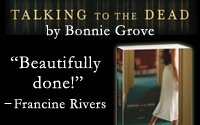
Long story, but I'm basically in happyland at the moment. I've written a fan-tab-ulous novel I call Talking to the Dead (you can have a look see at chapter 1 at my website http://www.bonniegrove.com/). I finished but a wee short few moments ago. . . okay, I actually finished it last a couple of months ago, and I've been working on selling the thing.


I've learned a few things.


Would you like to hear them?


Oh, great! Read on.


First thing I learned: I know nothing.


Seriously. I didn't know enough to know what it is I didn't know. And not for a lack of trying. I've read books on how to write books, I read books on how to sell books, I've read books on how to attend conferences, approach editors, write proposals, write query letters, sing 7 national anthems, and make Julianne fries.


All good stuff. I'm glad I read all of that stuff, but these books didn't teach me the one thing I needed to know: How do I choose the best publishing house for my novel?


Most of us are happy when a publisher, any publisher, shows interest in our work, right? And we should be! Great validation! Warm fuzzies! A shot at being published!


So we pursue any and all leads, any and all publishers who offer to take a peek at our manuscripts. I've had several publishers express serious interest in my novel. So, how does a writer choose? How do I know which publisher is the best one for my novel?


This is the situation I found myself in recently (I know, I know, nice problem to have - and it is).


The truth is, I don't know which house is the best one for my novel. I don't know which one is the best house for your novel either.


Who does?


An agent.


Boy, howdy what they know!


I was fortunate enough to have a conversation with an agent and what she was able to tell me that I had NO clue about, and had NO way of knowing sent my brain spinning. I hope I'm not putting undue presser on anyone, but I'm quite convinced that an agent is the way to go for any new author who has a well polished, excellent ms finished and ready to sell.


Here's the catch:


The agent has to LOVE your work. So you may need to speak to more than one in order to find the right fit.


What this agent knew was info I'd never seen in any book anywhere. What this agent has access to is mind blowing.


Oh yeah, she also told me that, even if you are in the middle of talking with a publisher, most are happy when an agent steps in and takes over the negotiations. They have a longstanding, professional relationship and it simply takes less work and effort to get the deal done.


I'll say one more thing about agents. I've read in many places that manuscripts get rejected because of a million little things that a writer could do wrong like stapling her manuscript, or forgetting to double space. But, my experience tells me that good writing, good books, get noticed.


Peace