Awhile ago I had a comment on the blog left by David Felter (check out his blog IdeaBridges). This is (in part) what he said:
"The faith of some individuals is insufficient to allow them to see them [the parables of Jesus] as "holy fictions." They must see them as true stories. What happens in many "true stories," is what I call the distraction of the concrete, which inhibits the communication of the abstract."
I've been rolling the term "holy fictions" around in my head ever since.
Jesus did use stories to help convey the truth about who God is and how He works. He talked about lost things, seeds of various kinds, kings, bridegrooms, good guys, and bad guys. He used illustrations from real life, but there's no doubt that the stories themselves were fiction.
Of course Jesus didn't just use fiction. The Sermon on the Mount is pretty literal. But when He wanted to talk about who God is, He usually told stories. Fictions.
So, why can't we get our heads around the fact that fiction is an essential link to understanding God?
I'm throwing it out there for discussion.
One thing I have noticed in that Christian culture (in North America) seems to embrace the idea that fiction is "merely entertainment". Which is nonsense. A brief perusal of history will tell you that literature has turned the tides of many epochs, has influenced many leaders, and has caused real change.
Fiction has the power to not just reflect current culture, but to lead it. It can deposit new ideas into people's minds and imaginations in a way that non-fiction cannot do. (not that I'm against non-fiction! Far from it!)
Fiction, as an act of worship.
That's what I'm striving for in my writing. Failing hopelessly, but striving none-the-less.
I want to write something God can inhabit. Something that, in spite of my limits, my flaws, my bad spelling (oh my, I'm a terrible speller!) and my pathetically small vocabulary, God can fill and reveal Himself to those who read it.
Then, like Adam and Eve in the garden, my work will be "clothed", not by any brilliance of my own, but by God who shows the reader depths that I can only guess at.
Monday, April 21, 2008


Thursday, April 17, 2008
Short fiction made long
 I'm writing these days. It feels good.
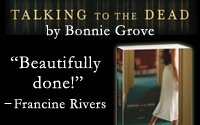
 I've been editing for so long, I feared I forgotten how to write. I've completed my novel Talking to the Dead and am shopping it around (yes, the same novel that was rejected by the publishing house I most wanted to accept it - sigh... genre is everything?).
I thought I would be starting on its sequel I'll Walk From Here, but I'm not. Nope. Not me. My brain flew off in a different direction and I'm running to catch up.
As you know Hot Apple Cider is out - most book stores will have it on order, or, if you are in the East, may have them on the shelves by now- and my short story The Stuckville Cafe is the anchor of the anthology (last story in the book).
The response I've gotten from the story has been an unanimous "MORE!!"
Flattering.
Humbling.
Cool.
So, I'm undertaking the task of turning a short story into a novella (trying to come in between 45,000 and 50,000 words). It's been an interesting exercise getting started. I thought I had my first chapter last week, but, as it turns out, what I had was just another version of a short story.
The "rules" of short story writing is different from those of novels. I know this. I feel it. I understand it on some basic level, but, like so many things about the craft of writing, I find it difficult to articulate the difference.
I suppose I could say that a short story needs to be concise, gripping, and move the reader through the beginning, middle, and end quickly. But, the same could be said for the novel, you just get to take your time a bit.
Yet, you don't. You still need to move the reader through the story with precision and timeliness. There are exceptions, but long gone are the days when writers could spend six pages describing the trees in the valley, the farmer's gnarled hands, or the shades of green found in the canopy.
For both short and long fiction the writer must engage the reader quickly, and hold their attention. And for both, you need to cover a lot of ground in a short time.

When I cracked open Jamie Langston Turner's novel Suncatchers I was swept up in a story that moved so quickly and covered so much ground I wondered what material she had left for the rest of the novel. And that's a good thing. She caught my attention and held it, sweeping my up in the tide of story.
So, I turned my attention back to my short story made long and re-wrote the first chapter. I've said before that while I seem to have a grasp of how this writing stuff is done, I suffer a great lack in explaining how it's done. Thus, I'm left with the favorite tool of any writer: showing.
Here is the original first few paragraphs of the novella At the Stuckville Cafe:
The town has a real name, but I call it Stuckville. Because, boy oh boy, I'm stuck here.
I own a cafe in this town of 2,300 people. Of course there's a sub-division going up right this minute, so that'll add forty new families. New customers. I sell ice cream, espresso drinks and Mexican food. I know the combination sounds cock-eyed, but most everything about this town is cock-eyed. Just take a look at the building my cafe is in, for instance. A giant two story slab of concrete rising up from its rickety foundation. The place was built in 1907, and the windows in my cafe are original. When you look through them everything outside is wavy and has a bluish tinge. Like looking through the bottom of a coke bottle.
The owner of the building painted the outside of it last summer, but I guess he used the wrong kind of paint, or something, because it's peeling off the walls in great strips and littering the street like a ticker tape parade everyone forgot to attend.
And here is the revised opening, the one that feels like a novel as opposed to a short story:
The town has a real name, but I call it Stuckville. ‘Cause, boy, oh, boy, I'm stuck here.
I accidentally bought a café here in Stuckville. I didn’t mean to, really, it just sort of happened. That’s what I’m going to have engraved on my tombstone; “It just sort of happened”. The sum total of my life so far. Not that I’m old. Not really. I’m thirty, which is an age I’ve always considered to be “old”, but now I see is very young. Youthful. Almost infantile, really. I can see the years stretched ahead of me that I still have to live. Vast spans of time to fill with. . . something. I just don’t know what yet.
At the moment I’m filling them with ice cream, espresso drinks and Mexican food. That’s what I sell in my café. I know the combination sounds cock-eyed, but most everything about this town is cock-eyed. I used to fill my years with other things, other people, but I don’t anymore. You could say I’m in the market for a new life. But new lives are hard to come by in a small town. How small? 2,300 people small. Most of them work in the big city that’s only about an hour drive from here. On weekdays you can fire a canon down Main Street and not worry too much about hitting anyone.
***
In the novel you have more room to tell your story, more time to let it unfold, but that's no excuse to be long winded. Novels aren't just short stories with descriptive padding. Each form has a distinctive feel.
Try taking one of your own short pieces and writing a chapter of it as if it were a novel.
I'd love to hear the results!
Monday, April 14, 2008
The sign just said "Books"
This is a post from another blog you'll find me on: The Word Guild's blog: http://twgauthors.blogspot.com/
Its a site where the professional members of the guild post (usually one post a day on weekdays) about life, writing, God, and other cool things. Check it out! In the meantime, here's a recent post of mine based on an experience I had recently.
The sign outside just said, “BOOKS”.
The shop is on Main Street, which isn’t really main at all anymore.Inside, the place inspired both awe and a vague sort of horror.
The owner, Wayne, stands at the front of the store surrounded by heaps of books that are stacked haphazard around his knees. He stays there, behind his ancient desk, looking like a prisoner of literature. He seems content enough, though, as he hollers out a conversation with another customer. Yelling that French Canadian Hockey Players are the best in the world and how Don Cherry taught him to watch TV with the sound off.
I tune him out and venture deeper into the place. It seems to go on forever. Room after room of yellowing books stacked as high as the ceiling. Boxes of unsorted books trip me and grab at my pant leg. I can’t seem to find the back of the store, the last room. For a surreal moment I feel like the star of a BBC children’s special; Bonnie and the Book Store, and I wonder if I will find a magical portal, or a talking dog, or a secret door that leads to outer space.
Rambling, ramshackle shelves stacked upon even more decaying shelves. Shelves that defy gravity. At one point I move my young daughter away from a wall because I can see with perfect clarity what it will look like when the whole thing just gives way. All the shelves are like this. Lilting to one side or the other; dilapidated, frightening.
It feels as if it has been here forever, as if it had sprung from the ground at the time of creation from some bad seed left to sprout on the wrong side of the gates of Eden. But I hear Wayne holler from the front, as if reading my mind, but I know he’s talking to someone up there, he says, “I’ve been here since 1991. . .” I don’t catch the rest, and I don’t mind. Seventeen years. Not all that long when you consider the depth, the breath of the place. The sheer mass.
I peruse the titles. Everywhere I look I see gems like The 1978 Art & Craft Market. Surely someone, somewhere is in need of the answers found in this book. I picture some desperate woman draped in a brown macramé vest with matching hat throwing herself on the mercy of Wayne, “Please! I need to find a place to sell my knick knacks! My home is over run! My husband is threatening divorce!” And Wayne will give her a calm assuring nod and motion her to follow him.
I found The New Sexuality (published in 1972. Does that make it the old sexuality?) in the sociology section. Judy Blume’s novel Smart Women nuzzled against a hard cover edition of Curing Fatigue.
Around another corner, through yet another doorway, I find a puzzling (and tiny) section with the mysterious distinction of “Women Novelists”. As if Wayne considered all the female writers in the fiction section merely girls. Doris Lessing made the cut, as did Daphne de Maurier. Janet Dailey did not.
I make my way to the front of the store, happy to see it again, happy to know it’s still there, that there’s an exit. But before I go, I plunk down two books and hand Wayne cash money for them. Two gems, real ones that, when I spotted them, made me grab them fast, like at a Boxing Day sale at Bloomingdales. One, a hard bound beauty, a piece of Americana that even a Canadian like me cannot help but cherish; a 1957 pressing of Art Linkletter’s Kids Say the Darndest Things. Illustrated by Charles Shultz, forward by Walt Disney. And the other was a book I’ve been searching for nearly 20 years; Book 3 of The Book of Lists.
I left that place with a smile on my face. And I knew I’d be back. Because, no matter the place, no matter the mess, no matter the bad service, no matter the perilous placement, books, good books, great books, are always worth the effort.
Its a site where the professional members of the guild post (usually one post a day on weekdays) about life, writing, God, and other cool things. Check it out! In the meantime, here's a recent post of mine based on an experience I had recently.
The sign outside just said, “BOOKS”.
The shop is on Main Street, which isn’t really main at all anymore.Inside, the place inspired both awe and a vague sort of horror.
The owner, Wayne, stands at the front of the store surrounded by heaps of books that are stacked haphazard around his knees. He stays there, behind his ancient desk, looking like a prisoner of literature. He seems content enough, though, as he hollers out a conversation with another customer. Yelling that French Canadian Hockey Players are the best in the world and how Don Cherry taught him to watch TV with the sound off.
I tune him out and venture deeper into the place. It seems to go on forever. Room after room of yellowing books stacked as high as the ceiling. Boxes of unsorted books trip me and grab at my pant leg. I can’t seem to find the back of the store, the last room. For a surreal moment I feel like the star of a BBC children’s special; Bonnie and the Book Store, and I wonder if I will find a magical portal, or a talking dog, or a secret door that leads to outer space.
Rambling, ramshackle shelves stacked upon even more decaying shelves. Shelves that defy gravity. At one point I move my young daughter away from a wall because I can see with perfect clarity what it will look like when the whole thing just gives way. All the shelves are like this. Lilting to one side or the other; dilapidated, frightening.
It feels as if it has been here forever, as if it had sprung from the ground at the time of creation from some bad seed left to sprout on the wrong side of the gates of Eden. But I hear Wayne holler from the front, as if reading my mind, but I know he’s talking to someone up there, he says, “I’ve been here since 1991. . .” I don’t catch the rest, and I don’t mind. Seventeen years. Not all that long when you consider the depth, the breath of the place. The sheer mass.
I peruse the titles. Everywhere I look I see gems like The 1978 Art & Craft Market. Surely someone, somewhere is in need of the answers found in this book. I picture some desperate woman draped in a brown macramé vest with matching hat throwing herself on the mercy of Wayne, “Please! I need to find a place to sell my knick knacks! My home is over run! My husband is threatening divorce!” And Wayne will give her a calm assuring nod and motion her to follow him.
I found The New Sexuality (published in 1972. Does that make it the old sexuality?) in the sociology section. Judy Blume’s novel Smart Women nuzzled against a hard cover edition of Curing Fatigue.
Around another corner, through yet another doorway, I find a puzzling (and tiny) section with the mysterious distinction of “Women Novelists”. As if Wayne considered all the female writers in the fiction section merely girls. Doris Lessing made the cut, as did Daphne de Maurier. Janet Dailey did not.
I make my way to the front of the store, happy to see it again, happy to know it’s still there, that there’s an exit. But before I go, I plunk down two books and hand Wayne cash money for them. Two gems, real ones that, when I spotted them, made me grab them fast, like at a Boxing Day sale at Bloomingdales. One, a hard bound beauty, a piece of Americana that even a Canadian like me cannot help but cherish; a 1957 pressing of Art Linkletter’s Kids Say the Darndest Things. Illustrated by Charles Shultz, forward by Walt Disney. And the other was a book I’ve been searching for nearly 20 years; Book 3 of The Book of Lists.
I left that place with a smile on my face. And I knew I’d be back. Because, no matter the place, no matter the mess, no matter the bad service, no matter the perilous placement, books, good books, great books, are always worth the effort.
Tuesday, April 8, 2008
I'm just making this up
Someone asked recently what was the difference between fiction and non-fiction.
I opened my mouth, ready to say something like, "Non-fiction is true, fiction is made up."
Thankfully, my gums flapped shut before such yammer fell from my mouth.
Later, I spent time thinking about the distinctions between the two - and there are distinctions, even as you read the question above, you were able, almost immediately, to classify the terms as different - categorize them in separate places in your brain, and retrieve details about the terms from separate places in your brain (aren't you amazing, look at you and your brain go!)- and I found myself thinking in circles.
Fiction - in all its forms tells stories that are far more true than some of the non-fiction I've read, even though the characters are made up. Fiction is what makes all the non-fiction in life digestible, interesting, pondering, thoughtful, glorious, frightening, comforting, exciting, and entertaining.
I'm at work on my second novel - which I thought was going to be the sequel to my first novel. I mean, I meant to be at work on the sequel to my first novel (which I'm still shopping around), but I'm not. I'm actually at work on a "sequel" to my short story The Stuckville Cafe which is hitting bookshelves May 15, 2008 as part of the Hot Apple Cider anthology. I've been getting such amazing and positive feedback from the story, even before it hits the shelves, that I'm convinced I need to write a full length novel based on the story. But, more about that later. For now, on to my point!
At The Stuckville Cafe is a work of fiction. But it's setting is real (but I won't say where the real Stuckville is), the people are real (names and identifying features have been changed to protect the innocent - and the not so innocent :) ), and the themes; love, hope, peace, joy, grace, etc. are more real than the skin I'm in.
I could, in fact, take the same info, the same themes, and the same settings, and write a non-fiction book about a real town, populated by real people, and the events that shape their lives. And it could be a great book, too. A sort of documentary (I love documentaries!), a slice of life time capsule captured in ink.
So, the difference between fiction and non-fiction isn't subject matter. It isn't characters, it isn't theme, or setting, or anything else that we think of that makes up a traditional fiction book. Because the components of story are the same if you're writing fiction or non-fiction. You use the same tools, they are just used differently. You have the same data, they are just arranged differently on the page and spoken in a different tone of voice.
And so, I fess up, I come clean, I throw up my hands and surrender.
I don't know what the difference is between fiction and non-fiction. Yet I do. I know it in my heart somewhere, in some swirling, windswept place where ideas come, but as soon as they arrive they are blown to the peripheral, just out of translatable reach.
But, I'm teachable.
What is the difference between fiction and non-fiction?
I opened my mouth, ready to say something like, "Non-fiction is true, fiction is made up."
Thankfully, my gums flapped shut before such yammer fell from my mouth.
Later, I spent time thinking about the distinctions between the two - and there are distinctions, even as you read the question above, you were able, almost immediately, to classify the terms as different - categorize them in separate places in your brain, and retrieve details about the terms from separate places in your brain (aren't you amazing, look at you and your brain go!)- and I found myself thinking in circles.
Fiction - in all its forms tells stories that are far more true than some of the non-fiction I've read, even though the characters are made up. Fiction is what makes all the non-fiction in life digestible, interesting, pondering, thoughtful, glorious, frightening, comforting, exciting, and entertaining.
I'm at work on my second novel - which I thought was going to be the sequel to my first novel. I mean, I meant to be at work on the sequel to my first novel (which I'm still shopping around), but I'm not. I'm actually at work on a "sequel" to my short story The Stuckville Cafe which is hitting bookshelves May 15, 2008 as part of the Hot Apple Cider anthology. I've been getting such amazing and positive feedback from the story, even before it hits the shelves, that I'm convinced I need to write a full length novel based on the story. But, more about that later. For now, on to my point!
At The Stuckville Cafe is a work of fiction. But it's setting is real (but I won't say where the real Stuckville is), the people are real (names and identifying features have been changed to protect the innocent - and the not so innocent :) ), and the themes; love, hope, peace, joy, grace, etc. are more real than the skin I'm in.
I could, in fact, take the same info, the same themes, and the same settings, and write a non-fiction book about a real town, populated by real people, and the events that shape their lives. And it could be a great book, too. A sort of documentary (I love documentaries!), a slice of life time capsule captured in ink.
So, the difference between fiction and non-fiction isn't subject matter. It isn't characters, it isn't theme, or setting, or anything else that we think of that makes up a traditional fiction book. Because the components of story are the same if you're writing fiction or non-fiction. You use the same tools, they are just used differently. You have the same data, they are just arranged differently on the page and spoken in a different tone of voice.
And so, I fess up, I come clean, I throw up my hands and surrender.
I don't know what the difference is between fiction and non-fiction. Yet I do. I know it in my heart somewhere, in some swirling, windswept place where ideas come, but as soon as they arrive they are blown to the peripheral, just out of translatable reach.
But, I'm teachable.
What is the difference between fiction and non-fiction?
Friday, April 4, 2008
What's in the offering?
It's funny what gets blowing in the wind.
Not long ago I began a discussion with some writers about issues and strengths within the publishing industry. I've also done a fair amount of reading publisher's blogs, and attending tele-seminars hosted by publishers.
It seems everywhere I turn there is a group discussing publishing. And many people are frustrated with one or more aspects of the process, or the product.
Not that the whole sheebang is going to pot. Not at all. On many fronts writing and publishing books is fantastical.
In this discussion we've been having here on the blog, as well as elsewhere, the question has come up often regarding the quality of writing that is being offered to the paying public.
Some people have pointed out that books are no longer aimed at intellectuals, or academics, but at the "masses". Not a statement of elitism, rather a comment on what the publishing industry is telling us is important to our culture.
How many times have you heard: If you want to get published fast, be famous first.
Ours is a culture of celebrity. We follow celebrities wherever they go. We know what toothpaste they use, where they party, and if they are, or are not wearing underwear.
It doesn't take a genius to figure out what a slippery slope we're on. We've begun to value mindless titillation over genuine substance. And the books that are out there are reflective of this decline.
Why? Because publishers what to keep the population unenlightened?
No.
Because publishers need to make money. And value has been placed on celebrity. That's where the money is.
Most books that have been published in the Christian markets that have been considered "controversial" have been Rob Bell's slick packaged much ado about nothing, and a few naval gazing Emergent Church guys. Donald Miller said he had trouble getting published because his work didn't fit with the existing macros that are out there (have you read Donald Miller? There's nothing at all controversial about him, he has plain old conservative evangelical theology, he just writes it differently).
So, where is original thought? Is in found in popular whiners like Dawkins? I don't think so. His form of hatred has been around for centuries. Is it found in the constantly re-released classics of yesteryear?
Or is it found in you? Or me? Do we hold the key to changing the direction our culture is facing?
Not long ago I began a discussion with some writers about issues and strengths within the publishing industry. I've also done a fair amount of reading publisher's blogs, and attending tele-seminars hosted by publishers.
It seems everywhere I turn there is a group discussing publishing. And many people are frustrated with one or more aspects of the process, or the product.
Not that the whole sheebang is going to pot. Not at all. On many fronts writing and publishing books is fantastical.
In this discussion we've been having here on the blog, as well as elsewhere, the question has come up often regarding the quality of writing that is being offered to the paying public.
Some people have pointed out that books are no longer aimed at intellectuals, or academics, but at the "masses". Not a statement of elitism, rather a comment on what the publishing industry is telling us is important to our culture.
How many times have you heard: If you want to get published fast, be famous first.
Ours is a culture of celebrity. We follow celebrities wherever they go. We know what toothpaste they use, where they party, and if they are, or are not wearing underwear.
It doesn't take a genius to figure out what a slippery slope we're on. We've begun to value mindless titillation over genuine substance. And the books that are out there are reflective of this decline.
Why? Because publishers what to keep the population unenlightened?
No.
Because publishers need to make money. And value has been placed on celebrity. That's where the money is.
Most books that have been published in the Christian markets that have been considered "controversial" have been Rob Bell's slick packaged much ado about nothing, and a few naval gazing Emergent Church guys. Donald Miller said he had trouble getting published because his work didn't fit with the existing macros that are out there (have you read Donald Miller? There's nothing at all controversial about him, he has plain old conservative evangelical theology, he just writes it differently).
So, where is original thought? Is in found in popular whiners like Dawkins? I don't think so. His form of hatred has been around for centuries. Is it found in the constantly re-released classics of yesteryear?
Or is it found in you? Or me? Do we hold the key to changing the direction our culture is facing?
Subscribe to:
Posts (Atom)


 Posts
Posts


