The Bible talks about the mystery of marriage - the blending of two souls into one. Goes so far as to akin this mystery with humanity's connection to God - complete, living, breathing, strange, beautiful.
One of my favorite things about being married to my husband, Steve, is the partnership we have. We're rowing in the same direction - and if one of us needs to turn the boat around for some reason, the other is there to help rudder the changes needed. We're on the same team, even if we don't always know what we're doing.
The partnership that comes with editing a book with a professional editor has, believe it or not, parallels to the mysterious connecting of two people working together as one. While not nearly as significant as connecting to God or to a spouse, the connection between two artists at work on the same project is nothing if not mysterious, strange, and beautiful.
My agent recently expressed her admiration for the editor I'm currently working with - "A gem" she said. "I trust her completely." Trust is that critical component in partnership. And when it comes to taking a literary blade to your book, nothing comes before it. Through the experience of working with an editor for the first time, I've come to trust her. And with trust comes mutual respect for each other and the project.
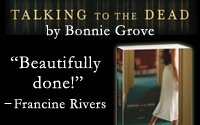
In an early conversation, Nicci brought up adding a large chunk of material to the book (it was sitting at around 80,000 words at that point). She gave me the reasons for the addition of about 20,000 words. Then she said, "I think we need to nix the sequel - tie everything up in this one book." I had already written 40,000 words on the sequel. It had a title and a cover (a deeply cool cover created by the same brilliant mind that created Talking to the Dead's fab cover). And here the dear woman was saying, "Let's scrap it, shall we?"
My reaction?
I smiled and said, "Absolutely, yes."
Why? Because of the mystery of partnership. I'd talked to Nicci enough before we began work on the book to know we shared a common passion: Making books that provide the best possible experience for the reader. Yes, I'm the writer, but the book isn't about me. It's about you, the reader. If fiddling with 60,000 words is what it takes to make the book a great read, I'm excited to do it. If it means abandoning a half-finished manuscript, so be it. And my editor feels the same way; it's not about her, it's about the reader. If that means she has double her work load, she will.
It makes no sense for the two of us to be so excited about creating so much work for ourselves. It makes no sense for us to want to spend weeks neck deep in changes, staring at words until our eyes blur and we can't remember what happened in the last sentence never mind the last chapter. But the mystery of partnership makes it possible. I'm no longer trodding the path alone, relying solely on my own resources for direction. I have this trusted friend who expertly leads and follows at the same time.
This week it got bad for us. Storm clouds, driving rain, the path washed away. I fell in the mud, and pulled her down with me. I felt responsible for the weather - still think I was - but within the mystery of our partnership, Nicci and I were able face the deluge, and even smile, then laugh. Two people giggling at the mess they'd made, certain the outcome would be worth the effort, and even more committed to creating the best reading experience possible.
And the sense that because she and I have been able to forge this mysterious connection, it will spill over to the reader and connect them as well - to me, to her, to each other.
Art is about the mysterious.
I bid you good writing.
Showing posts with label editing your work. Show all posts
Showing posts with label editing your work. Show all posts
Thursday, December 18, 2008


Saturday, December 13, 2008
Where Oh Where, Oh Where Is. . .
Bonnie?
Knee deep in sheep!
No, not sheep.
Words. Many many words. All mine. I tell - I've yakked on for 100 000 words and now my editor wants me to look at each one of them very, very closely.
Yep, I'm in line edits for Talking to the Dead. It's fun - in the same way waxing your legs before a hot date is fun.
Pain before pleasure, eh?
All this to ensure the book is amazing for your reading pleasure. I'm sure to blog about this experience. It's my first time, and I'm learning, learning. I love the partnership that comes with the editing process. And it's not over yet!
Deadline is Dec 18th and there's no way we'll miss it!
Gotta scoot! I'll fill you in soonest.
I bid you good writing.
Knee deep in sheep!
No, not sheep.
Words. Many many words. All mine. I tell - I've yakked on for 100 000 words and now my editor wants me to look at each one of them very, very closely.
Yep, I'm in line edits for Talking to the Dead. It's fun - in the same way waxing your legs before a hot date is fun.
Pain before pleasure, eh?
All this to ensure the book is amazing for your reading pleasure. I'm sure to blog about this experience. It's my first time, and I'm learning, learning. I love the partnership that comes with the editing process. And it's not over yet!
Deadline is Dec 18th and there's no way we'll miss it!
Gotta scoot! I'll fill you in soonest.
I bid you good writing.
Wednesday, November 19, 2008
Welcome Back Kelly McCrady
Kelly McCrady is back today with part II her article on being a writer AND an editor. Last time she spoke to us wearing her writer's hat. Today, take cover, because she's an editor - and she and her furious red pen have plenty to say!
Part II: “Dishing it out”
We turn now to the dark side, the Cave of the Editor.
The inbox dings. Message incoming from Senior Editor. “We have a query that looks fairly decent. You want to take this one?” Attached synopsis and query letter read okay, though the author is most likely unaware of how her lack of polish in the spelling, grammar and syntax makes her appear. No matter. The story seems to fit my line and the basic premise of a romance book, so I contact the author. I ask for the partial manuscript.
The partial arrives, and I schedule a time to do the read-through. Contact author, let her know the file arrived and when to expect an answer.
Edit books 1,2, and 3 currently on my desk. A gap will happen after book 3 is sent to galley-land, so at that time (no more than 60 days from receipt of initial query) I open the partial manuscript from Hopeful Author and read.
What you need to know as an author is that a book is judged as good or bad within the first six pages.
Six pages.
This does not mean the content cannot make or break the story’s potential after that, merely that my impulse to continue reading is generally triggered either direction by page six. If the prose isn’t up to publishable standard, as set down by my superiors at the publisher, I begin to compose the rejection letter. I look specifically for craft areas the author can improve on. That’s what we do at The Wild Rose Press—no form letters allowed.
If the first six pages have grabbed me so well that I’ve read to page fifteen without noticing, that is a good thing. I usually stop there and email the author to send me the full manuscript.
When that full arrives (you’d be amazed at the speed of email when it’s a positive experience for both parties), I open the file to be sure it is in one piece, alert the author that it did arrive, and again schedule a time to do the read-through.
The most difficult part of reading full manuscripts for consideration is NOT EDITING THEM. Forcing myself to read, and read only for content, plot, character, structure, voice…any one of those can go sadly awry beyond what I expected from reading the polished partial.
If I reach the end of the book and don’t have that “Yay! Good book!” feeling (and yes, books with problems such as head hopping, too many adverbs, unclear transitions, echo words, “junk” words, poor use of commas, etc. CAN give me that feeling, if everything else is right about the plot and structure and characters) then I have to compose a rejection. So hard to do that, when a book is almost there but not quite yet.
A fair percentage of the books I have rejected were excellent, well-written, stirring prose…but were not romances. Authors, make certain you follow the publisher’s submission guidelines. Look through their catalogue to see what else they publish, read blurbs, excerpts, look at cover art. For example, a good adventure with a love story entwined in the plot cannot be categorized as a romance if the hero and heroine marry on page 60 of a 380 page book and continue to work together to bring down their foe.
When a manuscript is accepted for publication, that manuscript will undergo at least one round of copyedits. Some writers are so clean that the only marks the editor makes regard pulling the punctuation in line with house style (for example, the serial comma in a list with a conjunction—leave it in? Take it out?). More often, though, the editor will have questions about content that is inconsistent within the manuscript, and guide the author into smoothing these bits so the reader will not hit “speedbumps.”
My favorite trick for tracking consistency within a manuscript is to set up a chart, a style sheet, broken down into pairs of letters, A-Z, and a column for miscellaneous facts. While reading for the first edit, I write down the name of every character as I run across them, every fact (Brandy lost her locket on Tuesday), and when I get tidbits of character description, I add that after the character’s name, to keep a running list of how this person is described.
This style sheet helps in two ways—easy to see if facts such as a character’s hair or eye color suddenly changes, and also to find repeat descriptions. One of my authors caught that she referred to the hero’s hair as “shaggy” way too often, and that she alternated between the words “couch” and “sofa,” ultimately choosing only one.
The editor’s job is to make the author look good. I polish my “babies” and declare when they are ready to go out into the world, the proud auntie of all the books I’ve worked on. In the end, few acknowledge the editor’s hand in making the story richer, better, deeper. The publisher’s name is on the book, and the author’s name. Once in a while, you’ll see a thank you to an editor in the dedication.
Remember, your editor is invested in your story too. She loved it when she read it the first time. And she contracted it knowing she’d have to read it over and over and over…
Be professional in your communications with your editor. As gabby as authors are, editors are just as talkative. If you have not received an answer, feel free to ask your questions again—emails can and do disappear. But be polite on the second ask as though the first was not heard. Allow your editor time to find your answer and reply. Sometimes she or he is waiting on someone else in the company in order to give you the best information.
I enjoy editing. I enjoy interacting with authors. I enjoy being an author. I do not enjoy interacting with editors as an author LOL. So I hear you. I’m still going to change the wording in that sentence, because it does not mean what you wanted it to say.
Kelly McCrady’s newest short story “Martial Hearts” is available October 15 from The Wild Rose Press http://www.thewildrosepress.com/ . Author website is http://www.kellymccrady.com/
*****
This is worth a second, maybe even third read. It's chock-a-block with little tidbits, great advice, and "soft knowledge" every writer needs to know. I know we all want to be the writer who produces that "Yay! Good book!" feeling in an editor. Let's keep at it!
I bid you good writing.
Part II: “Dishing it out”
We turn now to the dark side, the Cave of the Editor.
The inbox dings. Message incoming from Senior Editor. “We have a query that looks fairly decent. You want to take this one?” Attached synopsis and query letter read okay, though the author is most likely unaware of how her lack of polish in the spelling, grammar and syntax makes her appear. No matter. The story seems to fit my line and the basic premise of a romance book, so I contact the author. I ask for the partial manuscript.
The partial arrives, and I schedule a time to do the read-through. Contact author, let her know the file arrived and when to expect an answer.
Edit books 1,2, and 3 currently on my desk. A gap will happen after book 3 is sent to galley-land, so at that time (no more than 60 days from receipt of initial query) I open the partial manuscript from Hopeful Author and read.
What you need to know as an author is that a book is judged as good or bad within the first six pages.
Six pages.
This does not mean the content cannot make or break the story’s potential after that, merely that my impulse to continue reading is generally triggered either direction by page six. If the prose isn’t up to publishable standard, as set down by my superiors at the publisher, I begin to compose the rejection letter. I look specifically for craft areas the author can improve on. That’s what we do at The Wild Rose Press—no form letters allowed.
If the first six pages have grabbed me so well that I’ve read to page fifteen without noticing, that is a good thing. I usually stop there and email the author to send me the full manuscript.
When that full arrives (you’d be amazed at the speed of email when it’s a positive experience for both parties), I open the file to be sure it is in one piece, alert the author that it did arrive, and again schedule a time to do the read-through.
The most difficult part of reading full manuscripts for consideration is NOT EDITING THEM. Forcing myself to read, and read only for content, plot, character, structure, voice…any one of those can go sadly awry beyond what I expected from reading the polished partial.
If I reach the end of the book and don’t have that “Yay! Good book!” feeling (and yes, books with problems such as head hopping, too many adverbs, unclear transitions, echo words, “junk” words, poor use of commas, etc. CAN give me that feeling, if everything else is right about the plot and structure and characters) then I have to compose a rejection. So hard to do that, when a book is almost there but not quite yet.
A fair percentage of the books I have rejected were excellent, well-written, stirring prose…but were not romances. Authors, make certain you follow the publisher’s submission guidelines. Look through their catalogue to see what else they publish, read blurbs, excerpts, look at cover art. For example, a good adventure with a love story entwined in the plot cannot be categorized as a romance if the hero and heroine marry on page 60 of a 380 page book and continue to work together to bring down their foe.
When a manuscript is accepted for publication, that manuscript will undergo at least one round of copyedits. Some writers are so clean that the only marks the editor makes regard pulling the punctuation in line with house style (for example, the serial comma in a list with a conjunction—leave it in? Take it out?). More often, though, the editor will have questions about content that is inconsistent within the manuscript, and guide the author into smoothing these bits so the reader will not hit “speedbumps.”
My favorite trick for tracking consistency within a manuscript is to set up a chart, a style sheet, broken down into pairs of letters, A-Z, and a column for miscellaneous facts. While reading for the first edit, I write down the name of every character as I run across them, every fact (Brandy lost her locket on Tuesday), and when I get tidbits of character description, I add that after the character’s name, to keep a running list of how this person is described.
This style sheet helps in two ways—easy to see if facts such as a character’s hair or eye color suddenly changes, and also to find repeat descriptions. One of my authors caught that she referred to the hero’s hair as “shaggy” way too often, and that she alternated between the words “couch” and “sofa,” ultimately choosing only one.
The editor’s job is to make the author look good. I polish my “babies” and declare when they are ready to go out into the world, the proud auntie of all the books I’ve worked on. In the end, few acknowledge the editor’s hand in making the story richer, better, deeper. The publisher’s name is on the book, and the author’s name. Once in a while, you’ll see a thank you to an editor in the dedication.
Remember, your editor is invested in your story too. She loved it when she read it the first time. And she contracted it knowing she’d have to read it over and over and over…
Be professional in your communications with your editor. As gabby as authors are, editors are just as talkative. If you have not received an answer, feel free to ask your questions again—emails can and do disappear. But be polite on the second ask as though the first was not heard. Allow your editor time to find your answer and reply. Sometimes she or he is waiting on someone else in the company in order to give you the best information.
I enjoy editing. I enjoy interacting with authors. I enjoy being an author. I do not enjoy interacting with editors as an author LOL. So I hear you. I’m still going to change the wording in that sentence, because it does not mean what you wanted it to say.
Kelly McCrady’s newest short story “Martial Hearts” is available October 15 from The Wild Rose Press http://www.thewildrosepress.com/ . Author website is http://www.kellymccrady.com/
*****
This is worth a second, maybe even third read. It's chock-a-block with little tidbits, great advice, and "soft knowledge" every writer needs to know. I know we all want to be the writer who produces that "Yay! Good book!" feeling in an editor. Let's keep at it!
I bid you good writing.
Wednesday, October 22, 2008
Food for Thought - To Keep You Munching While I'm Away

I'm headed to the mountains of Alberta for a few days. So there won't be any posts until next week. Unavoidable - one of those "must do" annual things. I certainly don't resent the mountain scenery, the time alone with hubby, the rarefied air, BUT. . .
I'm sort of in the middle of something.
Like a deadline.
I'm sure every manuscript is different, and every writer who, head down, fingers flying works on rewrites has his/her own story - Here's a taste of mine:
I am on the crazy side of blessed to have Nicci Hubert as my editor. I don't know if it's considered proper etiquette to name one's editor outside of the acknowledgement on the book jacket, but since she and I are writing all over each others Facebook walls, I suppose it isn't much of a national secret anyway. As I was saying, I'm blessed. She has such a creative instinct and feel for authors.
So, one day she e-mails and sets up a time when we can talk on the phone. I had been thinking we would be going back and forth on e-mail over the book, changes to be made here, things to change there - that's what I thought. But, instead, we just had a phone call about the ms. Cool!
What needs a-changing? The answer is: everything and nothing. I'm actually adding about 30,000 words - which, interestingly, won't change the plot, rather they will intensify it. The additions will take what's there and ramp it all up into a more extraordinary read.
That is the benefit of having an extraordinary editor - she's sees the big picture in fresh ways and then helps you to focus sharply on the details involved.
Speaking of reading - someone asked me recently what my goal as a writer is.
It's a good question. And, I suppose, when one writes for the Christian market, as I do, one might feel compelled to answer in a spiritual way. But, as I thought about, the thing that came to mind was: My goal is to create the best reading experience possible for the reader.
That's what matters most to me as a writer. You. Your experience as you read. I picture you in my head finishing Talking to the Dead, closing the book, tossing it in air, hands over head and hollering "Yipee! That was FUN!"
Is that shallow of me? Should I not pursue loftier goals? Shouldn't my REAL goal be sharing Jesus with the world? World peace? Highlighting social injustice?
All good stuff. Great stuff. But, tell me, who will read it if it's not a wonderful reading experience? I'm not writing textbooks here. I don't expect my books to appear on high school required reading lists. People don't read novels because they HAVE to. They read them because the WANT to.
Honestly, I can't think of a higher goal than to create something people will enjoy.
So, when you are writing, remember: People first. Not your agenda, your message, your great ideas first. People first.
I bid you good writing.
Thursday, October 16, 2008
Welcome Guest Blogger - Debby Mayne - Self Editing

We've talked about self editing on the blog before. Today, Debby Mayne is here to give us a snapshot of the self-editing process. A suggestion would be to print out Debby's article and use it as a tip sheet, or step by step as you work your way through the editing process yourself.
Let's meet Debby:
Debby Mayne is a published author, Long Ridge Writers Group instructor, and speaker. Upcoming book releases include Peachtree Dreams in April 2009, Love Finds You in Treasure Island, Florida in June 2009, and Noah's Ark in October 2009
Editing your own writing is one of the most important things you can do before sending it off to a publisher. It doesn't matter whether you're pre-published or multi-published; ignoring this concept can be the kiss of death to that project and maybe even your future with that editor. You want your work to be polished and as professional as possible. Every writer has his/her own process, but most successful authors follow some or all of these basic steps.
First Draft
All writing starts with the first draft. Some writers labor over their work, and others purge their thoughts as fast as their fingers can type. Either way is fine. The initial writing has to happen before it can be revised.
First Read-Through
After the work is produced, it's always a good idea to look over it for grammatical, spelling, and consistency issues. I generally read the previous day's work and make corrections then move on to that day's writing. Not only do I correct as I go, it gets me back into the story. Some authors plow right through and wait until they're finished with the complete book/article/story before their first read-through. It doesn't matter which method you use as long as it brings you the result you need.
Cooling Off Time
It's always a good idea to put some time and distance between the first draft and the revision. This gives you the opportunity to look at your work more objectively since you're not so close to it. I like to write something completely unrelated to my project to freshen my perspective, sort of like cleansing the mental palate. For example, if I'm working on a fictional piece, I work on a nonfiction article before I revise my fiction.
First Round of Revisions
After I've separated myself from my work, I go back and look for opportunities to fine-tune the writing. The beginning of my project needs a strong introduction to capture the reader's attention. Each chapter needs a hook to keep her turning the pages. I replace as many passive verbs as I can with active verbs. Then I hunt for occurrences of pet words, such as "just," "that," "anyway," and "then," and either omit them or swap them out with other words or phrases. Other edits I make involve replacing dialogue tags with beats, strengthening dialogue, and varying sentence structure to keep a smooth flow to the writing.
Time, Sequence, and Consistency Revisions
Since I usually follow a detailed outline of the plot and have my character traits figured out before I begin, I check off each event as it unfolds in the story. I always go back and make sure each incident is well placed and makes sense after I'm finished because sometimes the characters have minds of their own, and they don't always behave. Each scene must move the story forward to the goal. Pacing needs to quicken and slow down at the right times with a balance of action, dialogue, and internal thought. All dialogue needs to be relevant. When I have seven days pass in my story, I make sure it equals a week in the story. If months go by, I show the important transformations of each character. Seasons also have to change as the story progresses. When I get to the end, I check to see if the resolution makes sense and isn't rushed.
Final Read-Through
Even after all that, I like to wait a few days then go back and read my story or article as a reader would. That gives me one last boost of confidence that the writing is as good as I can make it before I send it off to an editor. If anything jumps out at me, I highlight it and come back to fix it.
First Draft
All writing starts with the first draft. Some writers labor over their work, and others purge their thoughts as fast as their fingers can type. Either way is fine. The initial writing has to happen before it can be revised.
First Read-Through
After the work is produced, it's always a good idea to look over it for grammatical, spelling, and consistency issues. I generally read the previous day's work and make corrections then move on to that day's writing. Not only do I correct as I go, it gets me back into the story. Some authors plow right through and wait until they're finished with the complete book/article/story before their first read-through. It doesn't matter which method you use as long as it brings you the result you need.
Cooling Off Time
It's always a good idea to put some time and distance between the first draft and the revision. This gives you the opportunity to look at your work more objectively since you're not so close to it. I like to write something completely unrelated to my project to freshen my perspective, sort of like cleansing the mental palate. For example, if I'm working on a fictional piece, I work on a nonfiction article before I revise my fiction.
First Round of Revisions
After I've separated myself from my work, I go back and look for opportunities to fine-tune the writing. The beginning of my project needs a strong introduction to capture the reader's attention. Each chapter needs a hook to keep her turning the pages. I replace as many passive verbs as I can with active verbs. Then I hunt for occurrences of pet words, such as "just," "that," "anyway," and "then," and either omit them or swap them out with other words or phrases. Other edits I make involve replacing dialogue tags with beats, strengthening dialogue, and varying sentence structure to keep a smooth flow to the writing.
Time, Sequence, and Consistency Revisions
Since I usually follow a detailed outline of the plot and have my character traits figured out before I begin, I check off each event as it unfolds in the story. I always go back and make sure each incident is well placed and makes sense after I'm finished because sometimes the characters have minds of their own, and they don't always behave. Each scene must move the story forward to the goal. Pacing needs to quicken and slow down at the right times with a balance of action, dialogue, and internal thought. All dialogue needs to be relevant. When I have seven days pass in my story, I make sure it equals a week in the story. If months go by, I show the important transformations of each character. Seasons also have to change as the story progresses. When I get to the end, I check to see if the resolution makes sense and isn't rushed.
Final Read-Through
Even after all that, I like to wait a few days then go back and read my story or article as a reader would. That gives me one last boost of confidence that the writing is as good as I can make it before I send it off to an editor. If anything jumps out at me, I highlight it and come back to fix it.
*****
Rev up those red pens!
I bid you good writing.
Monday, September 22, 2008
Welcome Guest Blogger- Maggie Toussaint
Life's funny, isn't it? One day you are blogging regularly, the next an entire week flies by and you're left thinking, "Where did that week go? It was here a minute ago."

 Build a better story through editing
Edit mode. Some dread it. Some embrace it. Bottom line is that we all have to do it, even seasoned pros. Most authors follow a systematic process while editing their works of fiction. Here’s what I do, though it is by no means the only way to polish your work.
Elements of good writing must fit together seamlessly. Here are a few considerations: smooth transitions, character-specific dialogue, layering action tags to show the story, reducing backstory to non-impedable bits, and strengthening point of view. The nuts and bolts of character arcs and plot have to mesh too.
For me, editing comes down to layers of the book. First I check to make sure the story underpinning is strong. Once I’m satisfied, I make adjustments to the top layer. Both levels of editing help make your story and your voice unique.
Plot secures the story foundation. Reduce your story to one question. Mentally ask this question of every scene in your book. If you can’t come up with a related answer based on the scene’s content, you may need to strengthen your plot. Scenes and chapters should build upon each other.
Next, step into each POV character’s head and read only their scenes in the book. This tightens voice and eliminates repetitions. For the story to work, the main character(s) must change in some way over the course of the book.
When the plot and character arcs are satisfactory, turn your attention to the finer points. At first glance this may seem overkill, since the story already works, but this extra editing stage can make the difference between a rejection letter or The Call. Don’t skimp on effort here.
Editing books and editing systems abound. I’ve had great success with Margie Lawson’s EDITS system (http://www.margielawson.com/) and with Browne and King’s Self-Editing for Fiction Writers and Roerden’s Don’t Sabotage your Submission. Whatever system you decide upon, one of these or some other method, stick with it. Iron out exposition, telling scenes, clunky dialogue, droopy pacing, generic settings, and clichéd emotions and you’ll have a story that leaps off the pages.
Afterwards, let the book rest. The interval of rest is dependent on how long it takes you to view the book objectively again, whether it’s a week, a month, or a quarter of a year.
Finally, read your story aloud. Though everything seemed perfect before, this auditory stage can identify things you might have otherwise missed.
Although edit is a four-letter word, it can make a huge difference in the quality of your writing. Well-edited books separate professionals from amateurs. Good writing rises above the slush pile and ultimately attracts the kind of attention every author covets – publication.
So, it's been busy up here in the vast Canadian landscape, and an entire week was swallowed by the time bandits. Plus I've had a friend visiting for the past several days and we have been very busy goofing off.
Now, when we were last on the blog we had a great introduction to the levels of editing that can be done by a professional editor. Great stuff! But, how can we, as writers, self edit to our greatest advantage? Enter Maggie Toussaint and her article on how to build a better story using the skills and craft of editing.
Let's meet Maggie:

A scientist by training, a romanticist at heart, Maggie Toussaint loves to solve puzzles. Whether it’s the puzzle of a relationship or a who-dun-it, she tackles them all with equal aplomb and wonder. Maggie’s cozy mystery from Five Star, IN FOR A PENNY, is about a terrible golfer trying to save her best friend from a murder rap. Her three other published works are romantic suspense books, one of which won Best Romantic Suspense in the 2007 National Readers Choice Awards. Her day jobs include freelancing for a weekly paper and leading a yoga class. Visit her at http://www.maggietoussaint.com/.
 Build a better story through editing
Edit mode. Some dread it. Some embrace it. Bottom line is that we all have to do it, even seasoned pros. Most authors follow a systematic process while editing their works of fiction. Here’s what I do, though it is by no means the only way to polish your work.
Elements of good writing must fit together seamlessly. Here are a few considerations: smooth transitions, character-specific dialogue, layering action tags to show the story, reducing backstory to non-impedable bits, and strengthening point of view. The nuts and bolts of character arcs and plot have to mesh too.
For me, editing comes down to layers of the book. First I check to make sure the story underpinning is strong. Once I’m satisfied, I make adjustments to the top layer. Both levels of editing help make your story and your voice unique.
Plot secures the story foundation. Reduce your story to one question. Mentally ask this question of every scene in your book. If you can’t come up with a related answer based on the scene’s content, you may need to strengthen your plot. Scenes and chapters should build upon each other.
Next, step into each POV character’s head and read only their scenes in the book. This tightens voice and eliminates repetitions. For the story to work, the main character(s) must change in some way over the course of the book.
When the plot and character arcs are satisfactory, turn your attention to the finer points. At first glance this may seem overkill, since the story already works, but this extra editing stage can make the difference between a rejection letter or The Call. Don’t skimp on effort here.
Editing books and editing systems abound. I’ve had great success with Margie Lawson’s EDITS system (http://www.margielawson.com/) and with Browne and King’s Self-Editing for Fiction Writers and Roerden’s Don’t Sabotage your Submission. Whatever system you decide upon, one of these or some other method, stick with it. Iron out exposition, telling scenes, clunky dialogue, droopy pacing, generic settings, and clichéd emotions and you’ll have a story that leaps off the pages.
Afterwards, let the book rest. The interval of rest is dependent on how long it takes you to view the book objectively again, whether it’s a week, a month, or a quarter of a year.
Finally, read your story aloud. Though everything seemed perfect before, this auditory stage can identify things you might have otherwise missed.
Although edit is a four-letter word, it can make a huge difference in the quality of your writing. Well-edited books separate professionals from amateurs. Good writing rises above the slush pile and ultimately attracts the kind of attention every author covets – publication.
*******
I so agree with Maggie. Editing, like writing, is a stewed dish. You can't rush it, rather you need to take the time, not only to perform the work, but to let the whole thing simmer together over time before you revisit it. Fresh eyes are important! I was e-mailing with my NYC editor and she had to deliver the "bad" news that we would have to delay starting work on my novel for about a month. While we were both a tiny bit bummed about that, she pointed out that this afforded me more time to step back from my book and be able to come to it with fresh eyes once the process began.
Being able to distance your self emotionally from your work may sound difficult, but it is a crucial step on the road to being published. Writing is, above all, an intellectual pursuit.
I bid you good writing.
Friday, September 12, 2008
Welcome Guest Blogger - Angela Harms

Alright! From the last article on Fiction Matters, the one where John Ramsey Miller scared us out of our cotton socks, we all understand that we need a lot going for us as writers to get noticed, and to stay noticed. But what's a good first step? Besides actually writing something, I mean. The answer just might be: editing.
Now, there are lots of books out there about self-editing (some are better than others), but my experience tells me that, no matter how many times I comb over a section of my WIP, no matter how many times I tweak the words and fuss with punctuation, I'll miss something. Sometimes it's the whole boat I'll miss. That's where hiring an editor BEFORE you submit your work to an editor comes in. Confused? Our guest blogger Angela Harms is here to make it all make sense.
Angela Harms is a freelance editor and writer from the Pacific Northwest. She has been writing and editing for over 20 years, and particularly enjoys substantive editing of fiction. Her website is AngelaHarms.com. More of her articles can be found at WritersEditingWorkshop.com.
Writers have told me that the idea of working with an editor can be a little intimidating. I’d like to talk about what it’s like, how it works, and what an editor actually does.
Do you need an editor?
Do you need an editor?
“…everybody needs an editor.” —Michael Crichton
You’ve heard the advice before: everybody needs an editor. But surely that doesn’t mean everybody, right?
Your grammar and spelling are excellent. You understand that the revision process is vital, and you’ve asked friends to read your work and point out typos. And that’s all important, but—while I’m surely biased, being an editor myself—you might be surprised what a difference a professional editor can make, even after you’ve done all you can.
The difference between a talented friend and a professional editor
For example, I once had a writer who used the word shanghaied, as in “We got shanghaied.” The setting was about 1800. Trouble is, the term didn’t come into use until the 1850s. It’s not that editors have memorized those kinds of facts. But we are practiced in flagging them, and checking.
Another novel had a lovely woman in it, with the bluest eyes you’d ever seen. Until the next chapter; then they were green. Oops.
I’ve never seen a manuscript that didn’t need some level of editing.
What will an editor do?
As author, you make the decision about whether to accept any changes your editor suggests, and an editor should remind you of this. Anything that goes into your manuscript should go in there because you love it, not because you feel pressured to modify something to please the editor. That said, it’s also a good idea to talk to your editor about changes you disagree with, because if you talk about it, you’ll often discover that your editor was right, or—even better—the two of you together will come up with an even better solution. But in the end, it’s your work, and your decision.
Levels of Editing
Editors will talk about “levels,” but none of them talk about them the same way. Each editor has his or her own hierarchy, but here’s a basic breakdown of the levels your editor might recommend.
Light Edit: proofreading
Proofreading originally referred to comparing the edited manuscript with the galleys, or typeset pages, to be sure that they match. But in the twenty-first century, it usually means a light copyedit.
Proofreading originally referred to comparing the edited manuscript with the galleys, or typeset pages, to be sure that they match. But in the twenty-first century, it usually means a light copyedit.
A proofreader checks that a finished piece says what it was intended to say. That is, if a word is is repeated (Did you catch that?) it was probably not intended, and a proofreader will correct it. However, a proofreader won't comment if something is phrased awkwardly or a passage is wordy. Briefly, a proofreader looks for typing or typesetting errors, formatting errors, straightforward grammatical errors and misspellings that may have been missed during copyediting.
The proofreader should be the last person to work on the manuscript, and it should be a new person, a fresh set of eyes. Every published work needs a proofreader.
Medium edit: copyediting, or line editing
A copy editor will look for grammatical problems, spelling errors, factual or plot inconsistencies, too much use of passive voice, and anything else that will make it hard for the reader to enjoy the novel.
The editor will also create and follow a stylesheet. This is a guide that allows anyone who works with the manuscript to make sure the novel is consistent. How do you spell the main character’s name? How many commas do you use in a list? (“Peanuts, almonds and walnuts,” or “peanuts, almonds, and walnuts”?) What’s the correct name of the agency that’s investigating the UFOs, and how is it abbreviated?
You will receive queries asking you to clarify things or suggesting that you rephrase something to correct an error, but the copy editor won’t do the rewriting for you.
Fact-checking is usually part of the copy editor's job. Easily checked facts (that can be checked on-line in a moment) may be included in the copyediting fee (ask!), but extensive checking will usually cost extra.
Heavy edit: substantive editing, content editing
A substantive editor works as a partner with you, to help you create the best writing possible. The editor will help you to
¨ make sure the organization of the story makes sense
¨ find the perfect word or phrase
¨ strengthen your beginning
¨ remove words, paragraphs, even chapters that aren't doing their job
¨ move things around for better flow
¨ make your dialogue and descriptions more powerful.
A substantive editor will challenge you, and also help you create a novel you can be proud of.
Find out for yourself
Try this: google “free sample edit.” Visit a few of the websites, and find a couple of editors who appeal to you. Request a free sample. I’ll bet you’ll be surprised at what they are able to tell you. It’s worth your time to find an editor you enjoy, who understands your writing and who you understand as well. Once you do, I think you’ll find that your editor becomes a valued friend.
******
Thanks Angela!
Often a factor writers bring up about hiring an editor is the cost. Let's face it, writers (most of us!) aren't wealthy, we don't have money lying in drawers waiting for a rainy day. Hiring an editor costs money, and poor writers are reluctant to part with hard earned money. It may be helpful to think of this step in the process as a different kind of investment toward your writing goal. You've been investing huge amounts of time, talent, energy, and money already. Take time to evaluate the benefits of hiring an editor to work on your manuscript. Working with an editor before you submit your work to a publisher or agent will help you understand the process of editing, and better prepare you for when that big royalty paying publisher tells you, "YES!"
I bid you good writing.
Subscribe to:
Posts (Atom)


 Posts
Posts


